What's new in SDScribe™ 2023
· New selectable options for UN GHS 9 and Canada (“CA22”, WHMIS 2022 update).

Selecting a GHS version, SDS “2 Hazards” tab.
· Additional EU-prescribed hazard classifications (8 added for 2023)

· New SDS generation options to omit EU Table 3.1 index numbers and EC numbers.

· Option on program start-up to import the EPA’s Master List of per- and polyfluorinated alkyl substances (PFAS), containing about 12,000 chemicals.

Option to import EPA Master List of PFAS substances.
· New search for Substance records with PFAS listings.
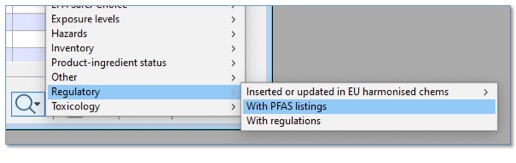
Finding Substances with PFAS content, in the Substances browse list.
· Substances with PFAS listings appear with a green “F” character on the Substances browse list, and on the “3 Composition” tab of the SDS entry form.

PFAS-containing Substance records have a green “F” in the “PF” column,
Substances browse list.

PFAS-containing Substance records have a listing on the “Regulatory” tab of the
Substances entry form…
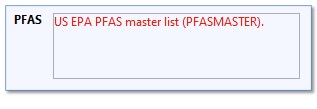
…as well as an alert on the “Green” Substances entry tab.
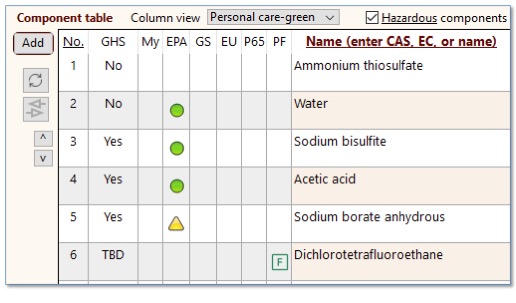
Appearance of a PFAS-containing ingredient (dichlorotetrafluoroethane)
in the Component table (“3 Composition” tab of the SDS).

PFAS listings for ingredients also appear on the “15.1 Regulatory” tab of the
SDS.
· Option on program start-up to import the ATP-18 harmonised substance classifications (EU Annex VI, Table 3.1).
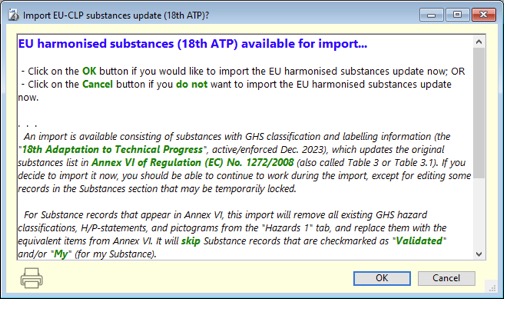
Option to import EU harmonized substances list (ATP-18).
· New search in the Substances browse list to find classifications that have either been added or updated in the various EU Adaptations to Technical Progress (ATPs).

Finding Substance records with EU hazard classifications that have been added
or updated in Appendix VI, Table 3.1, with the release of a particular
Adaptation to Technical Progress (ATP). Note that not all ATPs included changes
to Table 3.1.
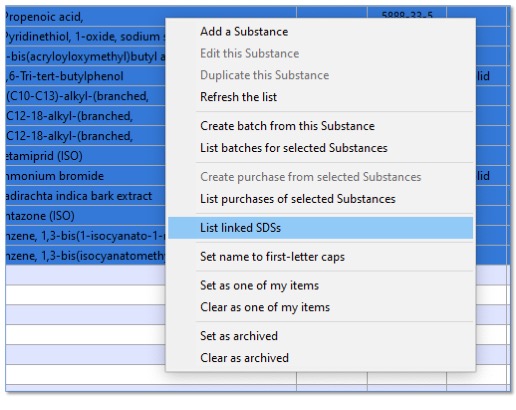
From a list of Substance records with EU hazard classifications that have
changed, right-click to locate the associated SDSs that might require
re-evaluation.
· The Component table (“3 Composition” tab of the SDS) now has columns for entering “display-only” minimum and maximum concentrations. A positive value in either/both of these columns will override the actual minimum and maximum concentrations on the generated SDS, for the ingredient.

New display-only concentration columns, Component table (“3 Composition” tab of
the SDS entry form). In this example, the 49 “Min% dsp”
and 55 “Max% dsp” values will appear for ammonium
thiosulfate in Section 3 of the generated SDS, rather than the
actual 50 “Min%” and 52 “Max%” values.
· Added new columns to the Component table: "M min" and "M max", for minimum and maximum molarity, which are relevant if the product is a dilute aqueous solution. Right-click on a row to calculate the minimum or maximum concentrations from the respective molarities. To perform the calculation, the program requires both molecular weight for the component (in its Substance record) and product density or specific gravity ("9 Phys-chem props" tab of the SDS record).
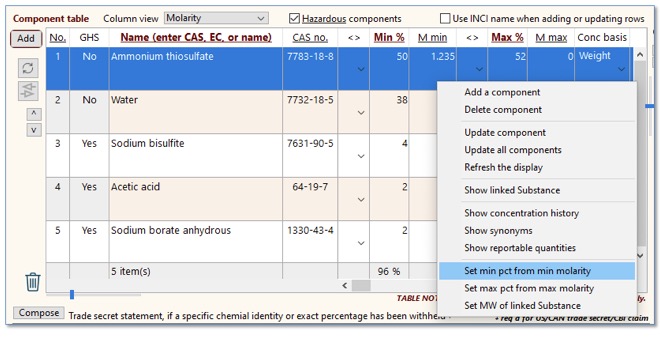
Recalculating minimum concentration (“Min%”) from minimum molarity (“M min”).
The program needs both component molecular weight (from the linked Substance
record); and product density or specific gravity (from the “9 Phys-chem props”
tab of the SDS).
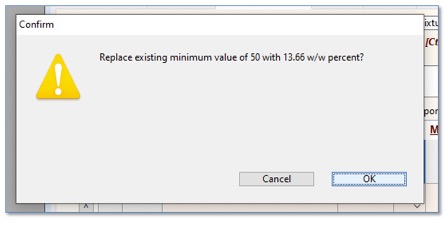
Program asks user to confirm replacement of the existing minimum concentration.
· Added a field for the DTXSID identifier, which links the Substance to a specific record in EPA's CompTox Chemicals Dashboard. Click on the adjacent link to open the web browser. Moved pesticide and MDL fields that were present in this location to the "Notes/other" tab.
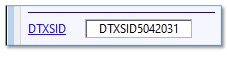
DTXSID field, “Identification” tab on Substances entry form. Field has a
clickable title for finding the Substance on EPA’s Comptox
Chemicals Dashboard.
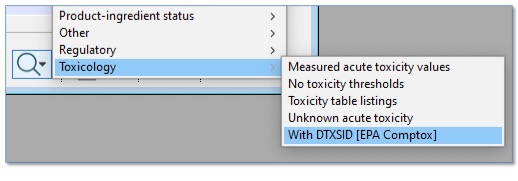
Finding records with DTXSID numbers, from Substance browse list.
· Added an "InChI key" (International Chemical Identifier key) field, on the “Notes/other” tab of the Substances entry form. Reorganized the tab for improved ease of use.
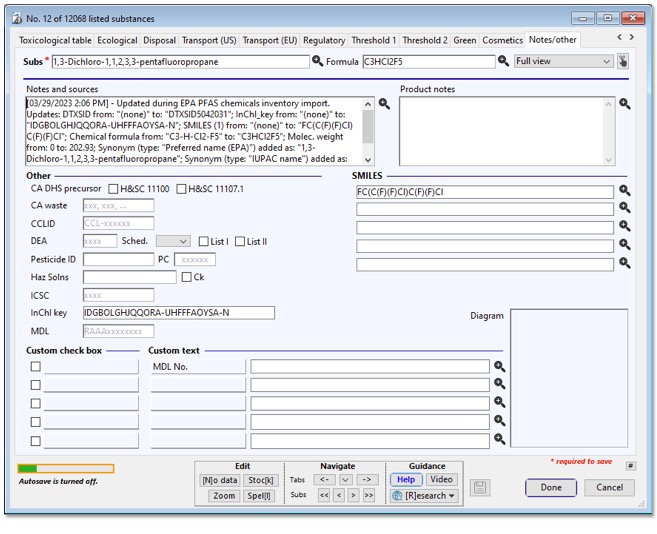
Reorganized “Notes/other” tab, Substances entry form, showing “InchI key” (International Chemical Identifier) field.
· The Quick Search box on the Substance browse list can now recognize and search for either a DTXSID or an InchI key value, without any prefix.
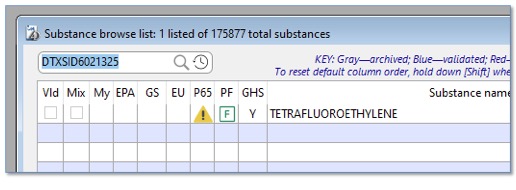
Quick Search box use for finding a Substance record on DTXSID number.
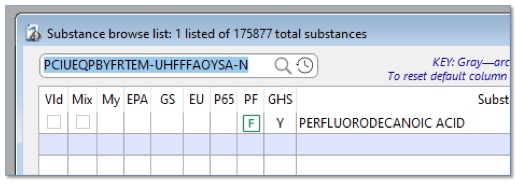
Quick Search box use for finding a Substance record on InchI
key (International Chemical Identifier).
[Rev. 5.17.2023]